Author Resource
Assisted publishing should make your book better — never take advantage of you. Here’s how to spot the bad actors and protect your work, your money, and your rights.
Fraud Alert
Publishing scams are rising, and fraudsters sometimes impersonate legitimate companies and their staff to trick authors into paying for “opportunities” that don’t exist. If someone contacts you claiming to represent Pristine Press & Media and anything feels off, pause and verify before you respond or pay.
These are not us
We are not affiliated with, owned by, or operated in partnership with Folio Creative Management, and we do not bill under names such as Moonveil Media Production. Any outreach, contract, or charge made under those names does not come from Pristine Press & Media.
Pristine Press & Media will never
When in doubt, ignore the message you received and reach us yourself through the channels above.
Think you’ve been targeted? Email admin@pristinepressandmedia.com so we can warn others — and don’t send money or sign anything until you’ve verified the contact.
Common impersonation tactics: “Guaranteed” publishing or distribution deals · promises of movie, TV, or streaming adaptations or major media exposure · fake contracts or invoices using our name or logo · claims of “exclusive” or “confidential” access with pressure to act fast · any request for money up front from an unverified contact.
The short version
Writing a book is deeply personal. After months or years of work, it’s natural to want to see it in print quickly — and that eagerness is exactly what predatory companies exploit. They know first-time authors often don’t know the industry’s norms, so they manufacture urgency, flattery, and impressive-sounding promises to get you to pay before you have time to think.
The good news: almost every scam follows a familiar pattern. Once you know what to look for, they’re easy to spot.
Know the playbook
These are the schemes that show up again and again in author communities and watchdog reports.
They tell you your manuscript was “selected” or “accepted,” then ask you to pay thousands for the privilege. A genuine traditional publisher pays you — it never asks you to fund your own book.
Legitimate literary agents earn a commission only when they sell your book. Any “agent” who charges a reading fee, evaluation fee, or retainer just to consider your manuscript is not a real agent.
Be wary of five-figure “marketing,” “media,” or “Hollywood pitch” packages that list no concrete deliverables, no timeline, and no way to measure a single result.
Some companies invent contests and “international book fairs” whose real purpose is to sell you an expensive booth, plaque, or listing that reaches almost no actual readers.
Unsolicited calls or emails claiming a producer, studio, or major publisher “found” your self-published book are almost always a sales funnel — not a real offer.
Watch for contracts that quietly claim your copyright, your subsidiary rights, or a long exclusive term. You should always keep ownership of your work.
Trust your gut
One of these alone may be innocent. Several together are a reason to walk away.
Do your homework
A trustworthy company will answer all of these happily, in writing.
Where we stand
We built Pristine Press & Media to be the opposite of the operations above. Our pricing is fixed and published in plain US dollars. You keep 100% of your rights and royalties — always. Every engagement is spelled out in writing before you pay a cent, and your first consultation is free with zero pressure. If a service isn’t right for your book, we’ll tell you.
This guide is general educational information, not legal advice. Before signing any publishing contract, consider having a qualified attorney review it.
Real example
An author we work with forwarded us these two emails. They are not from Simon & Schuster — a major publisher that is itself frequently impersonated this way — and they are not from us, though the sender invoked us to close the deal. Here is the anatomy, with her details removed.
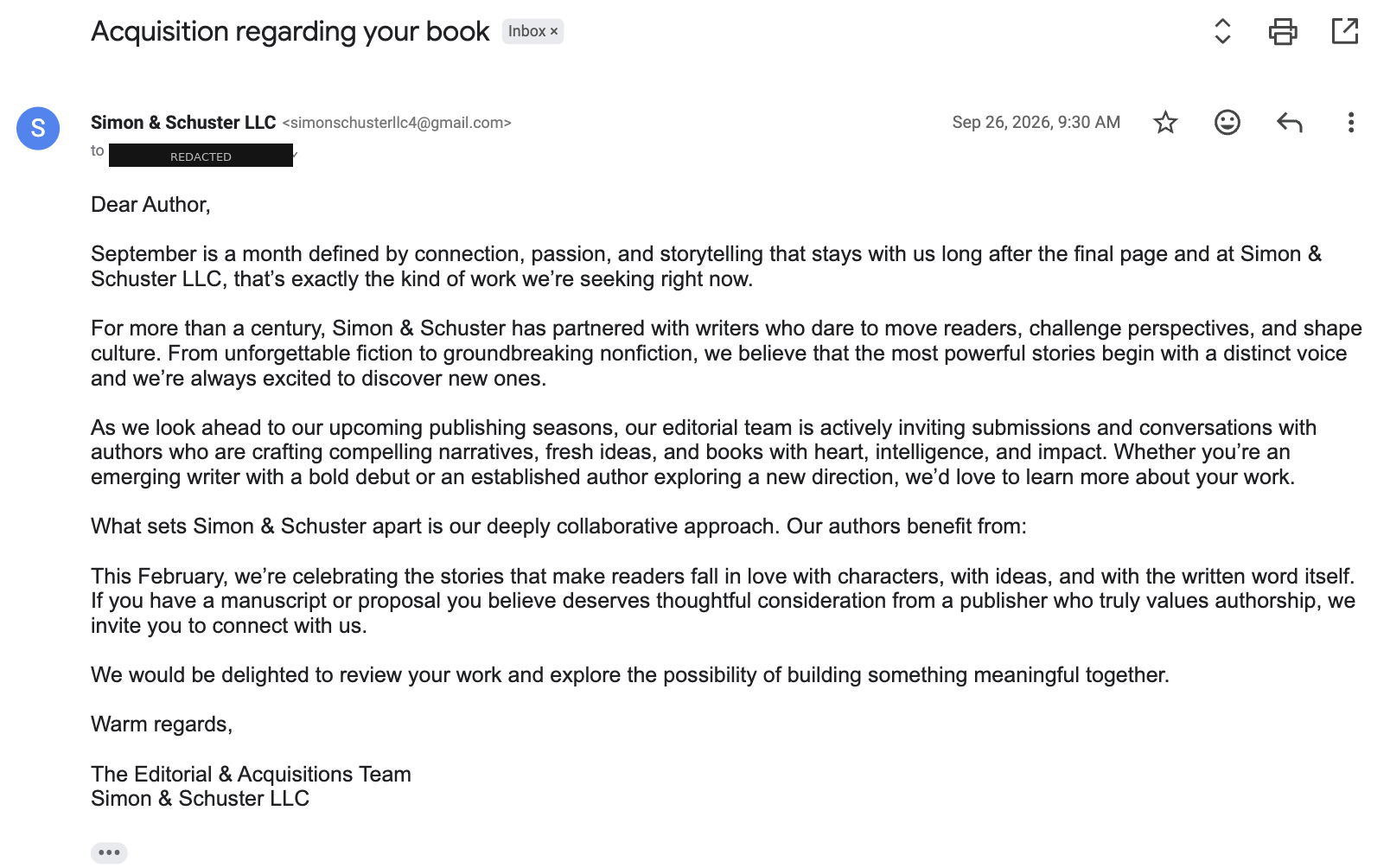
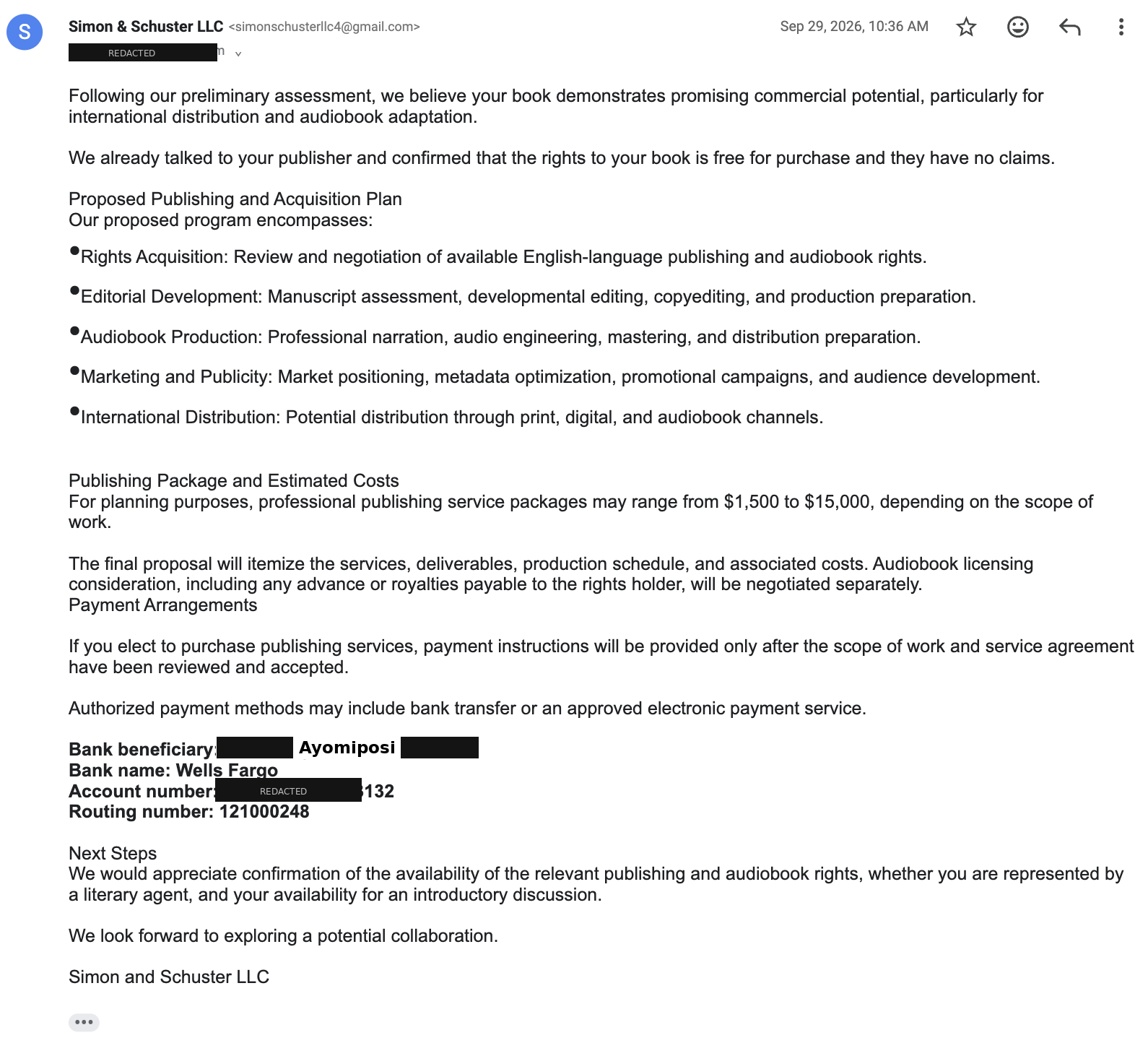
Notice what’s missing: they never email from @pristinepressandmedia.com, and we never ask you to pay to be “acquired.” If you receive something like this, verify it with us at admin@pristinepressandmedia.com before paying anyone.
Let's talk about your book
Tell us about your manuscript and where you want it to go. Your first consultation is free — no obligation, just a real plan.